Why Are Computer Science and Programming Important?
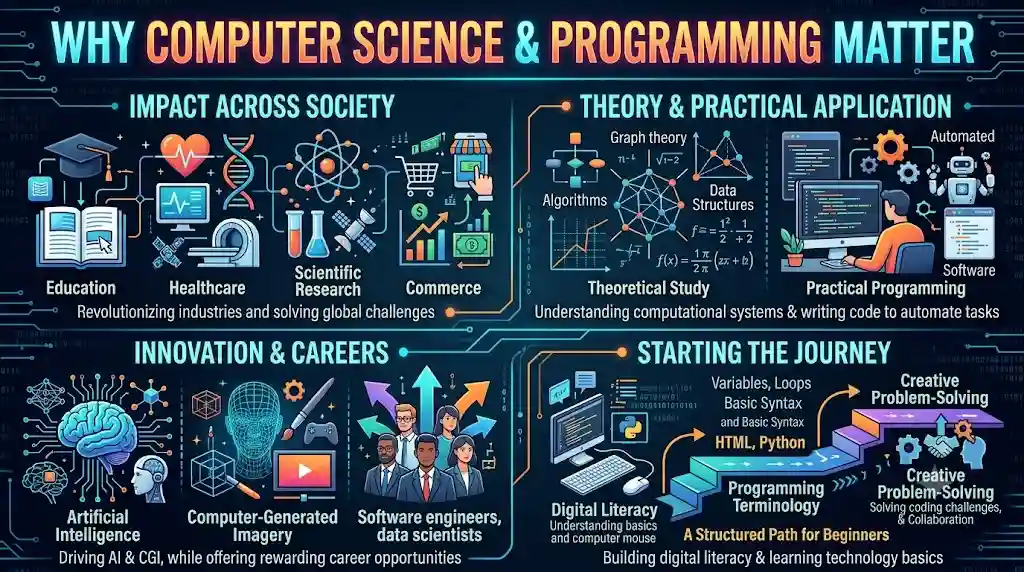
Computer science and programming have become essential parts of modern life. From smartphones and online banking to medical equipment, digital education, transportation, and entertainment, computer technology influences how people communicate, work, learn, and solve problems. Understanding computer science and programming helps us understand how these technologies function and how they can be used to create new solutions for everyday challenges.
In today’s digital world, computer science is not limited to software developers or technology professionals. It is relevant to students, teachers, business owners, researchers, healthcare workers, and anyone who uses digital devices. Learning its fundamentals provides the knowledge and skills needed to understand technology, think logically, and participate effectively in an increasingly digital society.
What Is Computer Science?
Computer science is the study of computers, computational systems, algorithms, data, and the principles used to design and develop software and technology. It explores how information is represented, processed, stored, and transmitted to solve problems efficiently.
Computer science includes several important areas, such as:
- Programming: Writing instructions that computers can execute.
- Algorithms: Developing step-by-step procedures to solve problems.
- Data structures: Organizing and storing data for efficient processing.
- Artificial intelligence: Creating systems that perform tasks associated with human intelligence, such as recognizing patterns and understanding language.
- Cybersecurity: Protecting computer systems, networks, and information from unauthorized access and attacks.
- Computer networks: Connecting devices so they can exchange information and share resources.
- Database management: Storing, organizing, retrieving, and managing information.
- Human-computer interaction: Studying how people interact with computer systems and how to make those systems easier to use.
Computer science combines logical reasoning, mathematics, creativity, and problem-solving. It helps us understand not only how computers work but also how to design better digital systems.
What Is Programming?
Programming is the process of writing, testing, debugging, and maintaining instructions that tell a computer how to perform particular tasks. These instructions are written using programming languages such as Python, Java, C, C++, JavaScript, and Swift.
Computers operate using machine-readable instructions, ultimately represented through binary values such as 0 and 1. Programming languages provide ways for humans to express operations and logic in forms that can be translated or executed by computers.
For example, a simple program can add two numbers, calculate the percentage of examination marks, display a message, or process thousands of records automatically.
Programming generally involves several steps:
- Understanding the problem: Identify what needs to be solved.
- Planning the solution: Design a logical sequence of steps or an algorithm.
- Writing the code: Express the solution using a programming language.
- Testing the program: Check whether it produces the expected results.
- Debugging: Find and correct errors in the code.
- Maintaining and improving: Update the program to fix problems or introduce new features.
Programming is not simply about memorizing commands. It requires understanding problems, breaking them into manageable parts, designing logical solutions, and improving those solutions through testing.
Why Is Computer Science Important?
1. It Powers Everyday Technology
Many devices and services used in daily life depend on computer science. Smartphones, laptops, smart televisions, digital cameras, washing machines, and navigation systems rely on software and computational processes to perform their functions.
When someone uses a smartphone to make a video call, take a photograph, check the weather, or navigate to a destination, computer systems process data and execute instructions behind the scenes.
Computer science helps engineers develop these systems, improve their performance, and introduce new features that make everyday activities more convenient.
2. It Improves Problem-Solving Skills
One of the most important benefits of studying computer science is the development of structured problem-solving skills. Computer scientists learn to analyze complex problems, identify patterns, divide tasks into smaller components, and develop systematic solutions.
These techniques are useful beyond programming. Students can apply them to mathematics, scientific research, business planning, personal budgeting, and many other situations.
For example, a student developing a program to calculate examination results must understand how to accept marks, calculate the total, determine the percentage, and display the result accurately. This process encourages logical thinking and careful analysis.
3. It Supports Scientific Research and Innovation
Scientists use computers to analyze large datasets, simulate complex systems, test theories, and conduct research that would be difficult or time-consuming to perform manually.
Computer science contributes to fields such as climate science, astronomy, engineering, agriculture, biotechnology, and physics.
For instance, researchers can use computer simulations to study weather patterns, analyze satellite images to monitor crops, or process astronomical observations to investigate distant objects in space.
These applications help researchers explore complex questions and develop new technologies.
4. It Transforms Education
Computer science has changed how people access and share knowledge. Online learning platforms, educational applications, digital libraries, virtual laboratories, and interactive learning tools allow students to learn from different locations and at different times.
Programming also enables educators to create educational websites, quizzes, simulations, and automated assessment tools.
Learning computer science can help students become more confident users of technology. It also prepares them to understand how digital tools work rather than simply using them without understanding the underlying processes.
5. It Strengthens Healthcare and Medicine
Modern healthcare relies heavily on computing technology. Hospitals use computer systems to manage patient records, schedule appointments, process medical images, monitor vital signs, and support clinical decision-making.
Medical imaging technologies, including CT and MRI systems, use sophisticated computational techniques to produce and process images of the human body. Researchers also use computers to analyze medical data and study potential treatments.
Artificial intelligence can assist with certain medical tasks, such as identifying patterns in images or helping prioritize cases. However, these systems have limitations and require appropriate clinical oversight.
Computer science therefore contributes to medical research, healthcare administration, diagnostic support, and the development of new medical technologies.
6. It Enables Communication and Connectivity
Email, instant messaging, video conferencing, social networking, and online collaboration tools depend on computer science and networking technologies.
These systems allow people to communicate across geographical boundaries, exchange information quickly, and work together remotely.
Businesses can coordinate teams in different countries, students can attend online classes, and families can maintain contact over long distances.
Computer networks, communication protocols, data processing, and security technologies work together to make these services possible.
7. It Supports Business and Economic Growth
Businesses use computer systems to manage inventory, process payments, maintain customer records, analyze sales, automate repetitive tasks, and make informed decisions.
Programming allows organizations to develop websites, mobile applications, accounting systems, customer-management platforms, and customized business tools.
Automation can reduce repetitive manual work, improve consistency, and increase productivity. Data analysis can also help businesses identify customer preferences, evaluate performance, and plan future activities.
Computer science creates opportunities for entrepreneurship by allowing individuals and organizations to build digital products and services for local and global markets.
8. It Helps Protect Digital Information
As more personal, financial, and business information is stored online, cybersecurity has become increasingly important.
Computer science provides the foundations for encryption, authentication, secure software development, network protection, and threat detection.
These techniques help protect sensitive information from unauthorized access, fraud, malware, and other digital threats.
Understanding basic cybersecurity principles also helps individuals develop safer online habits, such as using strong and unique passwords, enabling multifactor authentication, updating software, and recognizing suspicious links.
9. It Drives Artificial Intelligence and Automation
Artificial intelligence, machine learning, robotics, and automation are important areas of modern computer science.
AI systems can analyze data, recognize patterns, generate content, translate languages, and assist with tasks that once required extensive human effort. Machine learning enables systems to learn patterns from data rather than relying exclusively on manually specified rules.
Programming is central to building, testing, and integrating these systems.
However, AI systems do not automatically possess human understanding, emotions, or independent judgment. Their outputs can be inaccurate or biased, and important decisions often require human supervision.
Understanding computer science helps people evaluate these technologies more critically and use them responsibly.
Why Is Programming Important?
Computer science provides the broader theoretical and practical foundations of computing, while programming is one of the main ways people apply those foundations to create working systems.
Programming is important for several reasons.
Automation of repetitive tasks: Programs can perform repeated calculations, organize files, generate reports, and process large quantities of information much faster than manual methods in many situations.
Creation of software: Programming makes it possible to build websites, mobile applications, desktop software, games, and business systems.
Accuracy and consistency: Properly designed and tested programs can perform calculations and follow procedures consistently. Nevertheless, incorrect code or inaccurate input can still produce incorrect results.
Customization: Developers can create solutions for specific needs, whether they are designing a school management system, a personal finance tool, or an online learning platform.
Experimentation and creativity: Programming allows people to test ideas, create interactive experiences, develop prototypes, and transform concepts into functioning digital products.
Career development: Programming skills can support careers in software development, web development, data analysis, cybersecurity, artificial intelligence, game development, and other technology-related fields.
How Computer Science and Programming Are Used in Everyday Life
Computer science and programming are present in many familiar activities. The following examples demonstrate how they support modern society.
| Everyday application | How computer science and programming help |
|---|---|
| Smartphones | Run applications, process images, manage files, and connect to networks. |
| Online banking | Process transactions, maintain account records, and support security checks. |
| Digital payments | Exchange transaction information and communicate with payment systems. |
| Navigation apps | Process location information, calculate routes, and estimate travel times. |
| Online shopping | Manage product catalogs, shopping carts, payments, and order tracking. |
| Medical equipment | Process sensor data, generate images, and support medical monitoring. |
| CGI and animation | Create digital characters, visual effects, and computer-generated environments. |
| Agriculture | Analyze weather, monitor crops, and support precision-farming systems. |
| Education | Deliver online courses, interactive exercises, and digital assessments. |
| Entertainment | Stream media, render graphics, recommend content, and power video games. |
These applications demonstrate that computer science is not an isolated academic subject. It is a practical discipline that influences numerous aspects of daily life.
The Role of Computer Science in CGI and Entertainment
Computer-generated imagery, commonly known as CGI, is a particularly interesting example of computer science in action.
CGI is used to create or enhance visual content in movies, television programs, advertisements, video games, and animated films. Developers and artists use specialized software, mathematical models, algorithms, and rendering techniques to create realistic or imaginative scenes.
For example, a filmmaker can use CGI to create a fictional creature, simulate a large explosion, construct a digital environment, or show a futuristic city that does not exist in reality.
Several computer science concepts contribute to these effects:
- Computer graphics: Techniques for generating and displaying digital images.
- Geometry and mathematics: Methods for representing shapes, surfaces, lighting, and movement.
- Physics simulation: Algorithms that approximate effects such as gravity, collisions, smoke, and flowing water.
- Rendering: Processes that transform digital scene descriptions into images.
- Animation: Techniques for creating the appearance of movement.
- Programming: Instructions that coordinate calculations, visual effects, interactions, and rendering operations.
CGI illustrates how computer science combines technical knowledge with artistic creativity to produce compelling digital experiences.
Essential Computer Science Terminology
Understanding basic terminology makes it easier to learn programming and communicate about technology.
Computer: An electronic device that accepts input, processes data according to instructions, stores information, and produces output.
Hardware: The physical components of a computer, such as the processor, memory, keyboard, monitor, and storage devices.
Software: Programs and related instructions that tell a computer how to perform tasks.
Programming language: A formal language used to express instructions and logic for computer systems.
Source code: Human-readable program instructions written in a programming language.
Algorithm: A defined sequence of steps for solving a problem or performing a task.
Data: Facts, measurements, observations, or other information that can be processed by a computer.
Variable: A named element used by a program to store or refer to a value.
Function: A reusable unit of code that performs a particular task and may accept inputs or return a result.
Compiler: A program that translates source code into another form, such as machine code or intermediate code, before execution or further processing.
Interpreter: A program that executes source code or an intermediate representation through its runtime, commonly processing instructions incrementally.
Database: An organized collection of data that can be stored, searched, updated, and managed.
Operating system: System software that manages computer hardware and provides services for applications. Examples include Windows, Linux, macOS, Android, and iOS.
Network: A collection of connected devices that communicate and share information or resources.
Artificial intelligence: A field concerned with creating computer systems capable of performing tasks such as pattern recognition, language processing, and decision support.
Debugging: The process of identifying, investigating, and correcting errors in a program.
Cybersecurity: The practices and technologies used to protect computer systems, networks, applications, and information.
These concepts form a useful foundation for anyone beginning to study computer science or programming.
Computer Science and Programming as Career Opportunities
The growth of digital technology has created opportunities across many industries. People with relevant computer science and programming skills can work in technology companies, educational institutions, government organizations, financial services, healthcare, manufacturing, media, and other sectors.
Some common career paths include:
- Software developer
- Web developer
- Mobile application developer
- Data analyst
- Data scientist
- Cybersecurity analyst
- Artificial intelligence or machine learning engineer
- Database administrator
- Computer network engineer
- Game developer
- Systems analyst
- Computer science educator
Not every career requires the same level of programming expertise. Some roles emphasize software development, while others focus on data, infrastructure, security, research, or technical communication.
Computer science can also support entrepreneurship. People can use their skills to build websites, develop applications, create educational platforms, automate business processes, or launch digital services.
Although technology skills can improve career opportunities, success also depends on practical experience, communication, continuous learning, and the ability to solve real problems.
How Beginners Can Start Learning Computer Science and Programming
Beginners do not need advanced mathematical knowledge or expensive equipment to begin learning fundamental programming concepts. A computer or compatible mobile device, learning resources, and regular practice can provide a useful starting point.
A structured learning approach may include the following steps:
- Understand computer fundamentals: Learn about hardware, software, operating systems, memory, storage, and networks.
- Choose a beginner-friendly language: Python is often a practical starting point because its syntax is relatively readable.
- Learn basic programming concepts: Study variables, data types, operators, conditions, loops, functions, and input and output.
- Practice problem-solving: Solve small problems involving calculations, text processing, and logical decisions.
- Build simple projects: Create a calculator, quiz application, marks-percentage calculator, to-do list, or basic website.
- Learn debugging and testing: Understand how to identify errors and verify that a program behaves as expected.
- Explore specialized fields: Once the fundamentals are clear, investigate web development, databases, cybersecurity, data science, AI, or game development.
- Develop a project portfolio: Keep examples of completed projects to demonstrate practical skills and track progress.
Consistency is more important than trying to learn everything at once. Regular practice helps beginners gradually understand programming concepts and apply them to increasingly complex problems.
Challenges and Responsibilities in the Digital World
Although computer science offers many benefits, technology also creates challenges that individuals and organizations must address.
Privacy concerns arise when digital services collect and process personal information. Cyberattacks can compromise systems and expose sensitive data. Automation can change job responsibilities, requiring workers to develop new skills. AI systems may produce misleading results or reinforce biases present in their training data.
The digital divide also means that not everyone has equal access to reliable internet connections, computers, or quality educational resources.
Responsible computer science therefore involves more than making systems fast or efficient. Developers and organizations should consider accessibility, privacy, security, fairness, reliability, environmental impact, and the consequences of deploying technology.
Users also benefit from developing digital literacy, checking the reliability of online information, protecting personal data, and understanding the limitations of automated systems.
Conclusion
Computer science and programming are essential to understanding and shaping the modern digital world. They power everyday devices, support scientific research, improve healthcare, transform education, enable communication, strengthen businesses, and make innovations such as artificial intelligence and CGI possible.
Computer science provides the principles and methods used to understand computational systems, while programming enables people to turn ideas and algorithms into working software. Together, they encourage logical thinking, creativity, problem-solving, and technological awareness.
For students, professionals, entrepreneurs, and lifelong learners, understanding these subjects is a valuable investment in digital literacy and future opportunities. By learning fundamental concepts, practicing programming, and building practical projects, beginners can develop the knowledge needed to use technology more effectively and contribute to the digital world.