
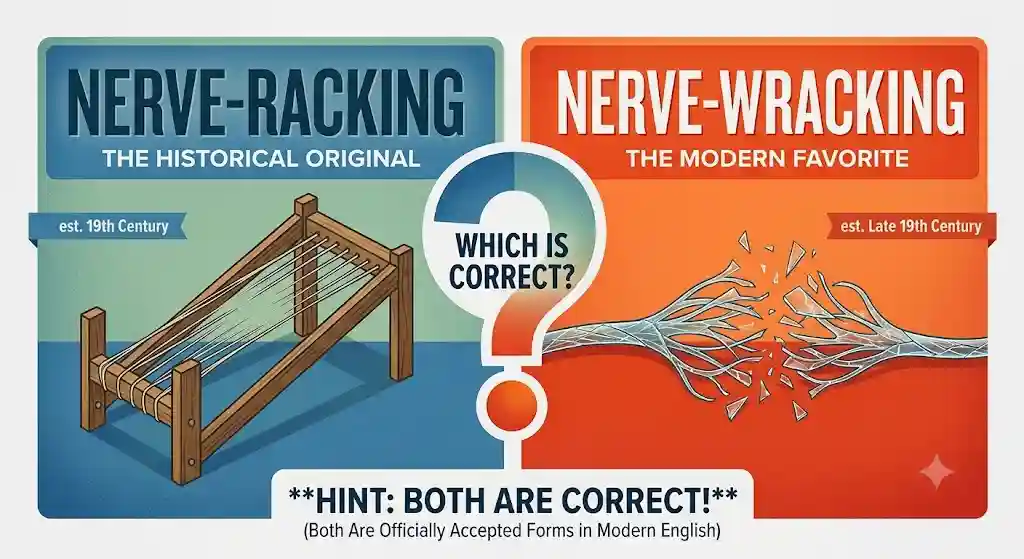
Is It Nerve-Racking or Nerve-Wracking? The Definitive Guide
The choice between nerve-racking and nerve-wracking is one of the most persistent dilemmas in modern English writing. If you have ever hesitated before typing the word, debating whether to include that silent w, you are in distinguished company. Authors, editors, and lexicographers have wrestled with the exact same choice for generations.
The straightforward answer is that both spellings are correct and fully accepted in modern standard English. However, the story behind why both exist—and how an apparent spelling mix-up evolved into acceptable usage—reveals a fascinating glimpse into how the English language changes over time.
The Historical Origin: The Case for ‘Nerve-Racking’
If you follow strict historical lineage and etymology, nerve-racking holds the title of the original, traditional spelling. It first began appearing in print during the early 19th century, with documented uses dating back as far as the 1810s and 1820s.
To understand why “rack” was the initial choice, you have to look at the medieval origins of the noun rack. Derived from the Middle Dutch word rec (meaning a “framework”), a rack was famously a torture instrument designed to stretch a victim’s body to its absolute limits.
When early 19th-century writers paired “rack” with “nerve,” they were invoking a vivid, visceral metaphor: an experience so intensely stressful that it felt as though your nerves were being physically stretched on a torture device.
“The happy hit produced a positive babel of uproarious applause, and we question whether the fair creatures who were the occasion of it, were proof against such nerve-racking shouts.”
— North Wales Chronicle, March 8, 1836
In style guides that favor traditional etymology, nerve-racking remains the preferred entry precisely because it honors this original mechanical concept of physical tension and strain.
The Expressive Alternative: The Rise of ‘Nerve-Wracking’
While nerve-racking came first, nerve-wracking made its entrance near the end of the 19th century. Its root, wrack, comes from the Old English words wracu and wræc, which are rooted in concepts of misery, persecution, vengeance, and ruin.
Wrack is closely tied to the word wreck. Because of this connection, choosing to spell the word with a w shifts the metaphor entirely:
- Nerve-racking: Your nerves are being pulled, stretched, and strained to their breaking point.
- Nerve-wracking: Your nerves are being completely ruined, wrecked, and destroyed.
Arguably, nerve-wracking carries a heightened sense of dramatic flair. Rather than simply enduring high tension, your emotional state feels utterly shattered by the ordeal.
Why Both Are Accepted Today
The transition from nerve-racking to nerve-wracking is a classic example of linguistic drift driven by homophones—words that sound identical but have different origins and spellings.
Because rack and wrack are pronounced the same way, and because both convey themes of distress and damage, everyday speakers naturally began conflating them. Expressions like “wrack and ruin” reinforced the idea that wrack was the proper word for devastation. Writers naturally assumed that a high-stress moment wrecked the nerves, so they added the silent w.
Over decades of widespread usage in published books, newspapers, and magazines, the “variant” spelling gained so much ground that it surpassed the original in popularity. Today, nerve-wracking is actually the more common spelling in modern published prose worldwide.
| Feature | Nerve-racking | Nerve-wracking |
|---|---|---|
| First Recorded Use | Early 19th century (~1812) | Late 19th century (~1890s) |
| Etymological Root | Rack (Middle Dutch rec – framework/stretching) | Wrack (Old English wracu – ruin/wreckage) |
| Core Metaphor | Nerves stretched under high tension | Nerves broken or destroyed |
| Modern Popularity | Traditional; favored by conservative style guides | More widely used in current publications |
| Status | Standard and fully accepted | Standard and fully accepted |
Which Form Should You Use?
Because both spellings appear regularly across major publications and dictionaries, you cannot go wrong with either choice. However, a few quick rules of thumb can help you decide:
- Check Your Publication’s Style Guide: Some formal publishing houses, academic journals, and news outlets (such as The New Yorker or specialized legal publishers) strictly adhere to nerve-racking out of respect for its longer historical precedent.
- Consider Your Audience: If you are writing for general audiences, digital platforms, or commercial fiction, nerve-wracking will likely look more familiar to the average reader.
- Maintain Consistency: The primary rule is internal consistency. Whichever version you choose, stick with that exact spelling throughout your entire document or manuscript.
Whichever path you choose, rest assured that neither spelling will invite the wrath of copy editors. While the debate over the silent w reflects centuries of shifting language, the physiological feeling it captures—the tight breath, the clammy hands, and the racing pulse—remains universally understood.
Frequently Asked Questions
Which is correct: nerve-racking or nerve-wracking?
Both spellings are correct and recognized by major dictionaries. Nerve-racking is the older, traditional spelling, while nerve-wracking is the more popular modern variant.
Why are there two spellings for this word?
The two spellings stem from different root words that sound identical (homophones). Rack refers to a medieval torture device that stretches things, while wrack is related to wreck and means destruction or ruin. Over time, writers used both metaphors, making both forms standard.
Which spelling is more popular today?
Nerve-wracking (with a w) is currently the more common spelling in modern books, digital media, and everyday usage worldwide.
Which spelling do style guides prefer?
Traditional news and academic style guides (such as The New Yorker or AP Stylebook guidelines in certain editions) often prefer nerve-racking because of its historical precedence. However, almost all style guides accept either option as long as you remain consistent.
Should I hyphenate nerve-racking and nerve-wracking?
Yes, both forms should always be hyphenated when used as a compound adjective (e.g., “a nerve-wracking interview”).

Leave a Reply