
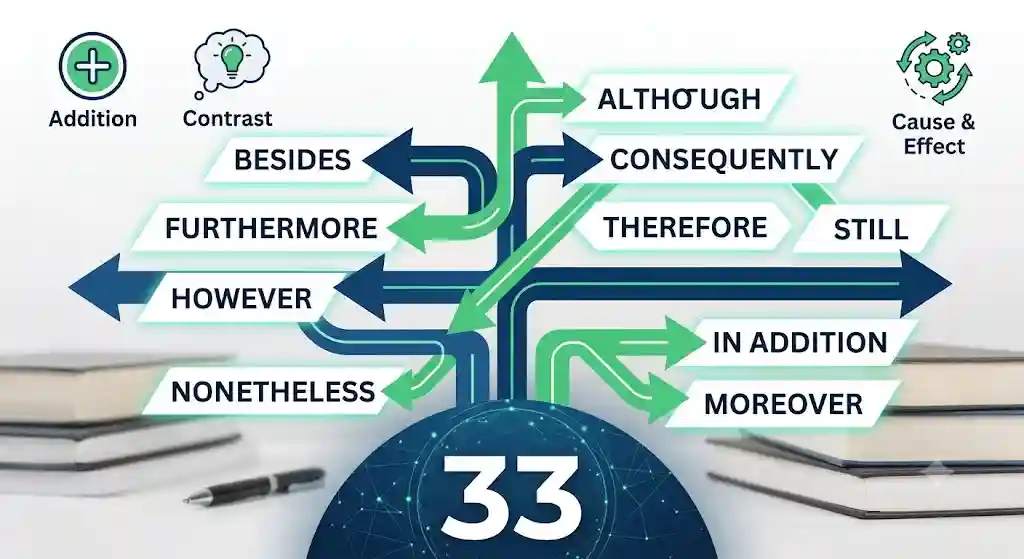
33 Essential Transition Words & Phrases (With Examples)
The strength of compelling writing rarely lies in the individual ideas alone, but in how seamlessly those ideas flow from one to the next. Transition words and phrases act as cognitive roadmaps for readers, signaling whether you are adding support, introducing a contrast, establishing cause and effect, or mapping a timeline. Without them, prose feels abrupt, disjointed, and exhausting to follow.
Mastering transitions means moving beyond basic connectors like “and” or “but” and recognizing the exact nuance each term brings. Categorized by their functional role in writing, here are 33 essential transition words and phrases, along with their definitions and contextual usage.
1. Building Logical Cause & Effect
These transitions demonstrate that a second statement follows as a direct consequence or logical deduction of the first.
- Accordingly
- Meaning: As a result; in a manner that corresponds to the circumstances.
- Example: The executive’s flight was delayed and they accordingly arrived late.
- Consequently
- Meaning: As an outcome or effect of the preceding fact.
- Example: The words are often confused and are consequently misused.
- Hence
- Meaning: For this reason; as a deduction from a preceding premise.
- Example: He was a newcomer and hence had no close friends here.
- Therefore
- Meaning: For that reason or cause; because of that.
- Example: This tablet is thin and light and therefore very convenient to carry around.
- Thereby
- Meaning: By that means; as a result of that action.
- Example: He signed the contract, thereby forfeiting his right to the property.
- Thus
- Meaning: Because of this or that; in this manner or degree.
- Example: This detergent is highly concentrated and thus you will need to dilute it.
2. Adding Information & Reinforcing Arguments
When introducing additional supporting evidence, extra details, or further context, these terms expand on an existing point without breaking the narrative flow.
- Additionally
- Meaning: In or by way of addition; furthermore.
- Example: The mountain has many marked hiking trails; additionally, there are several unmarked trails that lead to the summit.
- Besides
- Meaning: In addition to what has already been stated; moreover.
- Example: I can’t go, and besides, I wouldn’t go if I could.
- Further
- Meaning: In addition; going beyond what exists.
- Example: I had some money to invest, and, further, I realized that the risk was small.
- Furthermore
- Meaning: In addition to what precedes; used to strengthen a previous point.
- Example: These findings seem plausible. Furthermore, several studies have confirmed them.
- In addition
- Meaning: As something extra; added to what was stated.
- Example: The city has the largest population in the country and in addition is a major shipping port.
- Indeed
- Meaning: As a matter of fact; used to emphasize or strengthen a previous claim.
- Example: He likes to have things his own way; indeed, he can be very stubborn.
- Likewise
- Meaning: In a similar manner; also or in addition.
- Example: She is an acclaimed painter who is likewise a sculptor.
- Moreover
- Meaning: Beyond what has been said; introduces an important additional point.
- Example: It probably wouldn’t work. Moreover, it would be very expensive to try it.
3. Introducing Contrast & Counterpoints
Contrast transitions signal a shift in direction, highlighting exceptions, opposing viewpoints, or surprising qualifications.
- Albeit
- Meaning: Even though; although (typically introduces a short modifying phrase).
- Example: She appeared as a guest star on the show, albeit briefly.
- Although
- Meaning: In spite of the fact that; introducing a clause that qualifies a main statement.
- Example: They are good friends, although they don’t see each other very often.
- Conversely
- Meaning: In an opposing or contrasting way; looking at the flip side of an idea.
- Example: Large objects appear to be closer. Conversely, small objects seem farther away.
- Even so
- Meaning: In spite of that preceding fact; nevertheless.
- Example: These problems are not as bad as they were. Even so, there is much more work to be done.
- Even though
- Meaning: A emphatic form of “although,” used to highlight a stark contrast.
- Example: I’m planning to go even though it may rain.
- However
- Meaning: On the other hand; in spite of that.
- Example: I’d like to go; however, I’d better not.
- Nevertheless
- Meaning: In spite of what was just mentioned; nonetheless.
- Example: It was a predictable, but nevertheless funny, story.
- Nonetheless
- Meaning: Despite that; regardless of what has been stated.
- Example: The hike was difficult, but fun nonetheless.
- Notwithstanding
- Meaning: Without being prevented by; despite.
- Example: Notwithstanding their youth and inexperience, the team won the championship.
- Still
- Meaning: Despite that preceding fact; nonetheless.
- Example: I tried again and still I failed.
- Whereas
- Meaning: While on the contrary; comparing two differing facts or groups.
- Example: Some of these species have flourished, whereas others have struggled.
- Yet
- Meaning: Nevertheless; used to add a surprising or contrasting element.
- Example: It was pouring rain out, yet his clothes didn’t seem very wet.
4. Marking Time, Sequence & Condition
These terms orient the reader chronologically, show simultaneous events, or establish conditional boundaries.
- Afterward
- Meaning: At a later or succeeding time; subsequently.
- Example: Afterward, she got a promotion.
- Henceforth
- Meaning: From this specific point forward; starting now.
- Example: She announced that henceforth she would be running the company.
- Lest
- Meaning: For fear that; to avoid the occurrence of something undesirable.
- Example: He was concerned lest anyone think that he was guilty.
- Meanwhile
- Meaning: At or during the same time that another action occurs.
- Example: You can set the table. Meanwhile, I’ll start making dinner.
- Otherwise
- Meaning: Under different circumstances; if not.
- Example: Finish your dinner. Otherwise, you won’t get any dessert.
- Rather
- Meaning: More precisely; used to introduce a correction or clarification.
- Example: We can take the car, or rather, the van.
- Thereupon
- Meaning: Immediately after that sequence of events; upon that.
- Example: The committee reviewed the documents and thereupon decided to accept the proposal.
Summary Comparison of Core Transition Categories
| Function Category | Primary Role in Writing | Representative Examples |
| Cause & Effect | Demonstrates logical outcomes and deductions. | Therefore, Consequently, Thus, Hence |
| Addition | Expands upon, reinforces, or adds secondary details. | Furthermore, Moreover, Additionally, Besides |
| Contrast | Signals opposing ideas, caveats, or qualifications. | However, Conversely, Although, Nevertheless |
| Sequence & Condition | Establishes time frames, conditions, or precise phrasing. | Meanwhile, Afterward, Otherwise, Thereupon |
Strategic Usage: How to Choose the Right Transition
Selecting the correct transition comes down to identifying the precise relationship between your thoughts:
- Avoid Overuse: Inserting a transition at the start of every single sentence can make writing feel repetitive or mechanical. Allow natural sentence structures to do the work where logical progression is already obvious.
- Match the Tone: Words like thereupon, henceforth, and notwithstanding carry formal, academic, or legal weight. Conversely, terms like besides, even so, and yet fit comfortably into conversational or narrative prose.
- Punctuate Correctly: Conjunctive adverbs (such as however, furthermore, and consequently) joining two independent clauses usually require a semicolon before them and a comma after (“The road was clear; nevertheless, we drove cautiously.”).
Frequently Asked Questions (FAQ)
What are transition words and why are they important in writing?
Transition words and phrases connect sentences and paragraphs, showing the logical relationships between ideas. They improve readability and flow by guiding readers through cause-and-effect relationships, additions, contrasts, and timelines.
What are the main types of transition words?
Transition words are generally grouped into four main functional categories:
- Cause & Effect: Words that indicate logical outcomes (e.g., therefore, consequently, thus).
- Addition: Terms that add supporting information or reinforce a point (e.g., furthermore, moreover, in addition).
- Contrast: Words that signal opposing ideas or qualifications (e.g., however, conversely, although).
- Sequence & Condition: Indicators of timing, order, or prerequisites (e.g., meanwhile, afterward, otherwise).
How do I choose between formal and informal transition words?
Select transition words based on your audience and writing tone. Formal, academic, or legal contexts benefit from terms like notwithstanding, henceforth, or thereupon. Informal, conversational, or descriptive writing pairs better with natural connectors like besides, even so, or yet.
Can you overuse transition words?
Yes. Placing a transition word at the start of every sentence can make your writing feel repetitive, rigid, or mechanical. Use them strategically when introducing a shift in direction, adding evidence, or clarifying a complex logical connection.

Leave a Reply