
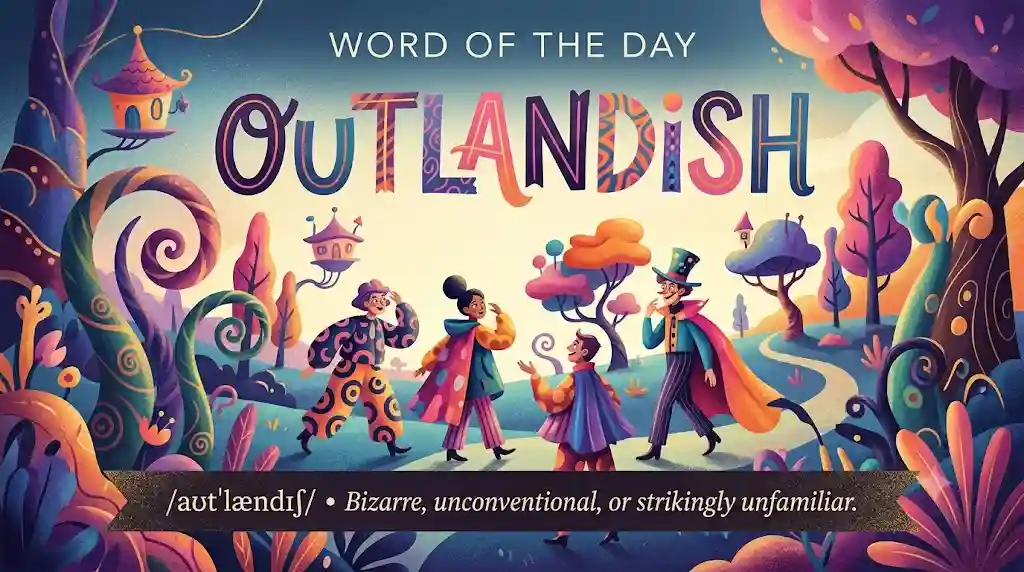
Word of the Day: Outlandish
Pronunciation & Phonetics
- IPA:
/aʊtˈlændɪʃ/ - Syllabification: out-land-ish
- Part of Speech: Adjective
Definition
Outlandish describes something strikingly bizarre, unconventional, or unfamiliar, often to the point of being absurd or visually startling. It denotes ideas, behavior, fashion, or designs that sit well outside standard social norms or reasonable expectations.
Etymology & Historical Drift
The word derives from the Old English ūtlandisc, a compound formed from:
- ūt: “out”
- land: “country” or “land”
- -isc: the adjectival suffix denoting origin (cognate to modern -ish)
Originally recorded in the late 9th century, outlandish was strictly geographic. It meant simply “foreign,” “alien,” or “originating from outside our borders.”
During the late Middle English to Early Modern English period (circa late 16th century), domestic observers frequently perceived foreign customs, clothing, and manners as bizarre or incomprehensible. Consequently, the word underwent semantic pejoration and broadening—shifting from a neutral descriptor of geography (“from an outer land”) to a qualitative description of anything wildly unconventional, grotesque, or shockingly unfamiliar.
Nuance & Semantic Usage
outlandish operates at the intersection of eccentric, gaudy, and absurd. While words like unusual or atypical remain neutral, outlandish carries a distinct theatricality. It rarely applies to modest anomalies; instead, it highlights deliberate extravagance, extreme implausibility, or sensory shock.
- In Fashion & Art: Denotes avant-garde designs that border on impractical or surreal.
- In Discourse & Ideation: Used to characterize conspiracy theories, wild claims, or policy proposals that defy empirical logic.
- In Everyday Behavior: Points toward eccentric or provocative social maneuvers.
Lexical Comparisons
| Word | Connotation | Key Distinction vs. Outlandish |
| Outlandish | Striking, bizarre, alien, absurd | Implies a dramatic departure from standard conventions; highly noticeable. |
| Bizarre | Odd, surreal, discordant | Focuses more on internal strangeness or incongruity than alien extravagance. |
| Eccentric | Quirky, idiosyncratic | Often applies to individuals or personal habits rather than claims or items. |
| Peculiar | Distinctive, mildly odd | Softer tone; suggests specific uniqueness rather than loud weirdness. |
| Preposterous | Absurd, contrary to reason | Emphasizes logical impossibility rather than sensory or stylistic oddity. |
Example Sentences
- Academic/Formal:
“The committee dismissed the hypothesis not because it challenged orthodox mechanics, but because it relied on outlandish mathematical assumptions unsupported by experimental data.” - Journalistic/Critique:
“The runway presentation featured outlandish headpieces constructed entirely from recycled circuit boards and industrial wire.” - Narrative Prose:
“He possessed a knack for weaving the most mundane neighborhood encounters into outlandish tales of international espionage.”
Memory Anchor
Mnemonic: Picture a traveler dressed in clothes from “out” of this “land”—bright, baffling, and turning heads wherever they walk. If it looks like it belongs to an alien province, it is outlandish.
Frequently Asked Questions (FAQ)
1. What does the word “outlandish” mean?
Outlandish is an adjective that describes something remarkably strange, bizarre, or unconventional. It is typically applied to ideas, behaviors, designs, or fashions that depart drastically from accepted standards or expectations, often to the point of being absurd or startling.
2. What is the origin and etymology of “outlandish”?
The word traces back to the Old English term ūtlandisc, combining ūt (“out”), land (“country” or “homeland”), and -isc (the adjectival suffix “-ish”). Historically, it carried a neutral geographic meaning: “of foreign birth” or “from an outer land.” Over centuries, domestic suspicion or amusement toward unfamiliar foreign manners shifted its meaning from simply “foreign” to “bizarre and unconventional.”
3. How does “outlandish” differ from “bizarre” or “eccentric”?
While all three convey nonconformity, their points of emphasis differ:
- Outlandish emphasizes extravagant, loud, or alien departures from normal convention (e.g., an outlandish outfit or claim).
- Bizarre denotes an uncanny, surreal, or internally discordant quality.
- Eccentric refers primarily to individuals or habits characterized by quirky, harmless departures from ordinary social patterns.
4. Can “outlandish” be used in professional or academic writing?
Yes. While it frequently appears in cultural critique and journalism, it is completely acceptable in formal and academic discourse to characterize extreme, unsubstantiated hypotheses, untenable claims, or highly irregular data sets that lack empirical grounding.
5. What are common synonyms and antonyms of “outlandish”?
- Synonyms: Bizarre, preposterous, fantastical, outlandish, idiosyncratic, garish, eccentric.
- Antonyms: Conventional, ordinary, standard, commonplace, traditional, orthodox.
Leave a Reply