
Overview
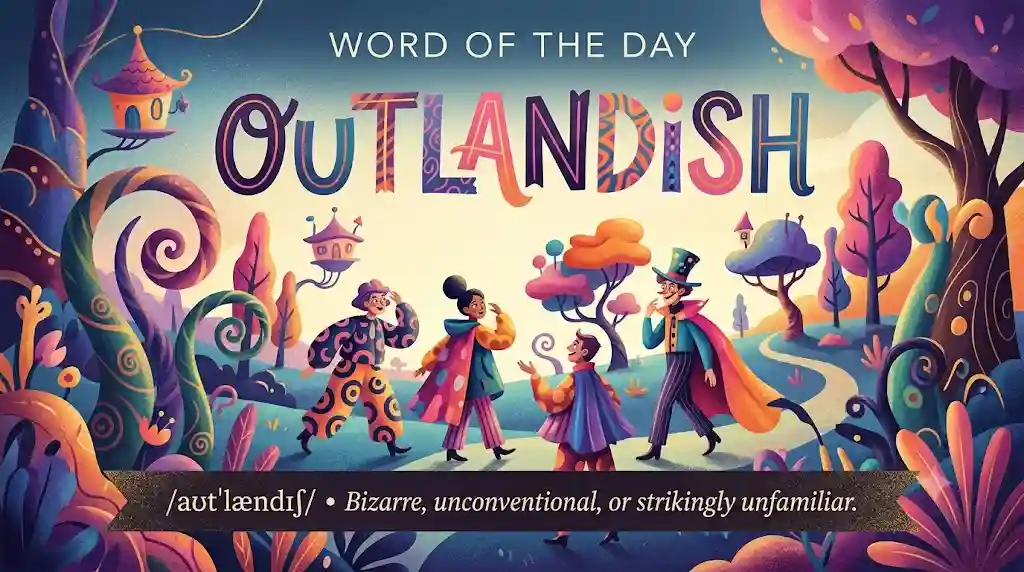
Outlandish is an adjective used to describe something that looks, sounds, or strikes the mind as extraordinarily strange, bizarre, unconventional, or unfamiliar. In modern usage, it often characterizes ideas, outfits, behavior, or theories that deviate sharply from accepted norms or common sense.
Pronunciation
- IPA (International Phonetic Alphabet): /aʊtˈlænd.ɪʃ/
- Phonetic Respelling: owt-LAN-dish
- Syllable Breakdown: out-land-ish (3 syllables)
- Primary Stress: Second syllable (
-land-)
Definitions and Functions
- Part of Speech: Adjective
- Comparative & Superlative: More outlandish, Most outlandish
Core Definitions
- Strikingly unconventional or bizarre: Peculiar, odd, or extravagant in appearance, manner, or concept.
- Example: He arrived at the formal gala in an outlandish neon-pink trench coat.
- Far-fetched or implausible: Unreasonable, preposterous, or difficult to believe.
- Example: The defense presented an outlandish conspiracy theory to explain away the evidence.
- Archaic / Historical: Foreign, alien, or originating from a distant country or territory.
- Example: Early chroniclers often marveled at the outlandish customs of traders from across the seas.
UPSC & Competitive Exam Perspective
In civil services and verbal aptitude exams (UPSC CSAT, SSC CGL, Banking, State PSCs), outlandish regularly tests semantic nuance and reading comprehension tone analysis.
- Tone Detection: Indicates an author’s skepticism, critical detachment, or amusement toward an unverified proposal, excessive claim, or fringe viewpoint.
- Contextual Nuance: Unlike unique or novel (which carry positive connotations of innovation), outlandish leans towards skepticism or absurdity, though it is less inherently hostile than deranged or grotesque.
- Common Trap: Conflating outlandish with geographical “outlying” or “outback.” While related historically, outlandish in modern English never denotes physical rural placement—it solely denotes strangeness or eccentricity.
Etymology and History
- Old English Roots: Derived from the Old English word ūtlendisc, formed from ūt (out) and land (land), combined with the suffix -isc (-ish). It literally meant “of an outer land” or “foreign.”
- Middle English Evolution: Transitioned through Middle English as outlandissh, applied to travelers, goods, or languages from unfamiliar foreign territories.
- Semantic Shift: Around the late 16th and 17th centuries, domestic populations viewed foreign attire and speech as peculiar. Consequently, the meaning drifted from geographic origin (“from another country”) to psychological impression (“weird, unfamiliar, bizarre, or grotesque”).
Grammar and Linguistic Usage
- Syntactic Placement:
- Attributive: Placed directly before a noun (an outlandish suggestion).
- Predicative: Following a linking verb (her fashion choices were outlandish).
- Collocations:
- Nouns: Outlandish claim, outlandish costume, outlandish theory, outlandish rumor, outlandish behavior.
- Adverbs of Degree: Utterly outlandish, somewhat outlandish, downright outlandish, thoroughly outlandish.
- Tone & Connotation: Informal to semi-formal; primarily descriptive with a mild to moderate tone of skepticism, surprise, or humor.
Symbolism and Cultural Importance
In literature and pop culture, the “outlandish” archetype serves as a disruptor of stagnation and conformity.
- Literature & Satire: Satirists use outlandish scenarios (e.g., Jonathan Swift’s Gulliver’s Travels) to hold a mirror to society by framing routine human vices as absurd alien habits.
- Fashion & Subcultures: Avant-garde designers and counter-cultural movements embrace outlandish styling deliberately to subvert mainstream aesthetic boundaries.
- Folklore & Mythology: Mythological creatures and tricksters are traditionally depicted with outlandish features to signal their detachment from ordinary mortal rules.
Usage in Technology and the Internet
- Clickbait & Viral Algorithms: Digital headlines frequently leverage outlandish claims to provoke curiosity gaps and drive social media shares.
- Speculative Tech: Radical concepts—such as atmospheric geoengineering, Dyson spheres, or mind-uploading—are frequently debated on tech forums under the banner of “outlandish yet theoretically plausible” engineering.
- Meme Culture: Visual internet humor relies heavily on juxtaposition, where an outlandish image or text disrupts an otherwise ordinary context.
Usage in Science
- Fringe vs. Paradigm Shift: In theoretical physics and cosmology, hypotheses such as the multiverse, quantum retrocausality, or panspermia were initially labeled outlandish before mathematical frameworks or observations gave them formal consideration.
- Evolutionary Biology: Refers to extreme morphological adaptations resulting from runaway sexual selection (e.g., the male peacock’s tail or the stalk-eyed fly).
Spelling and Word Formation
| Component | Element | Morphological Role |
|---|---|---|
| Prefix / Base 1 | Out- | Directional prefix denoting exterior or beyond |
| Base 2 | -land- | Root noun representing country, territory, or ground |
| Suffix | -ish | Adjectival suffix denoting origin, characteristic, or nature |
Derived Forms
- Adverb: Outlandishly
- Noun: Outlandishness
- Related Root Noun: Outland (remote or outlying region)
Rhyming Words
- Exact / True Rhymes: Brandish, blandish, standish
- Slant / Near Rhymes: Outlandishness, commandish, expand-ish
Synonyms, Related Words, and Antonyms
| Category | Words | Meaning / Distinction |
|---|---|---|
| Direct Synonyms | Bizarre, eccentric, preposterous, peculiar | Carries the exact sense of striking oddity |
| High-Intensity Synonyms | Grotesque, ludicrous, absurd, surreal | Suggests distortion or extreme irrationality |
| Contextual Relatives | Avant-garde, unconventional, flamboyant, idiosyncratic | Deviates from norms, often creatively |
| Exact Antonyms | Conventional, ordinary, standard, customary | Aligns precisely with expectations and traditions |
| Mild Antonyms | Typical, familiar, unremarkable, commonplace | Lacks distinct or unusual features |
Multilingual Equivalents and Regional Translations
| Language | Translation / Equivalent | Script / Transliteration | Contextual Meaning |
|---|---|---|---|
| Hindi | अजीब, अनोखा, बेतुका | Ajeeb, Anokha, Betuka | Strange, unusual, or absurd |
| Odia | ଅଦ୍ଭୁତ, ବିଚିତ୍ର, ଅସ୍ୱାଭାବିକ | Adbhuta, Bichitra, Aswabhavika | Peculiar, extraordinary, unnatural |
| Bengali | অদ্ভুত, কিম্ভূতকিমাকার | Adbhut, Kimbhutkimakar | Weird, oddly shaped |
| Sanskrit | विलक्षण, अद्भुत | Vilakshana, Adbhuta | Distinctive, extraordinary |
| Spanish | Extravagante, estrafalario | Extravagante, estrafalario | Quirky, bizarre in dress or manner |
| French | Bizarre, extravagant, farfelu | Bizarre, extravagant, farfelu | Eccentric, wacky |
| German | Skurril, abwegig, sonderbar | Skurril, abwegig, sonderbar | Whimsical, far-fetched, strange |
Notable Facts
- A “False Negative” Compound: Despite beginning with out-, the word has no connection to actions like outrun, outsmart, or outdo (which indicate exceeding someone else). Its structure mirrors older directional geography, similar to inland or upland.
- Shakespearean Absence: While William Shakespeare expanded the English vocabulary with hundreds of coined words, outlandish predates him by centuries, having survived directly from Old English oral traditions.
- Semantic Inversion: The word shifted from an objective legal and geographical status (“he is an outlandish merchant,” meaning foreign-born) to a subjective psychological assessment of weirdness.
Frequently Asked Questions (FAQ)
1. What is the primary meaning of the word “outlandish”?
The word outlandish is an adjective that describes something remarkably strange, bizarre, unconventional, or outside ordinary expectations. It can refer to eccentric clothing, unusual behavior, far-fetched concepts, or bizarre theories.
2. What is the historical origin (etymology) of “outlandish”?
It originates from the Old English word ūtlendisc, formed from ūt (“out”) and land (“land”) with the suffix -isc (“-ish”). Originally, it meant “foreign” or “coming from an unfamiliar land.” Over centuries, the meaning shifted from a geographic description to a psychological one—describing anything that appears foreign, odd, or bizarre.
3. How is “outlandish” tested in competitive exams like UPSC CSAT or SSC CGL?
In competitive exams, examiners evaluate:
- Author’s Tone: Identifying if a writer uses “outlandish” to express skepticism, disbelief, or critique toward a hypothesis or claim.
- Contextual Vocabulary: Differentiating it from neutral words like novel or innovative (which imply positive progress) and extreme terms like insane or grotesque.
- Common Pitfalls: Ensuring candidates do not confuse it with geographical terms like “outlying” or “outback.”
4. What are the best synonyms and antonyms for “outlandish”?
- Synonyms: Bizarre, eccentric, preposterous, peculiar, quirky, unconventional, outlandish.
- Antonyms: Conventional, ordinary, customary, standard, typical, unremarkable.
5. What are the Hindi and Odia equivalents of “outlandish”?
- Hindi: अजीब (Ajeeb), अनोखा (Anokha), बेतुका (Betuka).
- Odia: ଅଦ୍ଭୁତ (Adbhuta), ବିଚିତ୍ର (Bichitra), ଅସ୍ୱାଭାବିକ (Aswabhavika).
6. Can “outlandish” have a positive meaning?
While traditionally used to indicate doubt, skepticism, or absurdity, in creative fields like avant-garde fashion, art, and modern tech innovation, it is occasionally used in an appreciative sense to highlight bold, non-conformist, and boundary-pushing ideas.
Leave a Reply